

Introduction
Performance analysis has become one of the most valuable techniques in modern sports. Whether you follow football, cricket, basketball, tennis, or any other competitive game, understanding how players perform can help coaches, athletes, analysts, and even fans make smarter decisions. Instead of relying only on opinions, performance analysis uses measurable data, observations, and statistics to evaluate every aspect of a player’s game.
In today’s competitive environment, teams use advanced software, video recordings, wearable technology, and statistical models to examine strengths, weaknesses, and overall consistency. Even amateur teams now recognize that small improvements identified through analysis can make a significant difference over an entire season.
For beginners, Player Performance Analysis may seem complicated because of the large amount of available data. However, the process becomes much easier when broken into simple steps. By learning what to measure, how to collect information, and how to interpret results, anyone can gain valuable insights into athletic performance.
This guide explains everything you need to know about Player Performance Analysis. You’ll discover its importance, learn a practical step-by-step approach, explore its benefits and limitations, avoid common mistakes, and find expert tips that can improve your understanding of sports performance evaluation.
What is Player Performance Analysis?

Player Performance Analysis is the systematic process of evaluating an athlete’s performance using statistics, observations, video footage, and technology. The objective is to identify strengths, weaknesses, patterns, and opportunities for improvement.
Rather than judging a player based on a single match, analysts examine multiple performances to understand long-term consistency. The collected information helps coaches design better training programs while allowing players to improve specific skills.
Performance analysis generally includes:
- Technical skills evaluation
- Tactical decision-making
- Physical fitness assessment
- Mental performance analysis
- Statistical measurements
- Video review
- Match comparisons
For example, in football, analysts may evaluate passing accuracy, successful tackles, distance covered, sprint speed, and positioning. In cricket, batting averages, strike rates, bowling economy, and fielding efficiency are commonly measured.
Why is Player Performance Analysis Important?
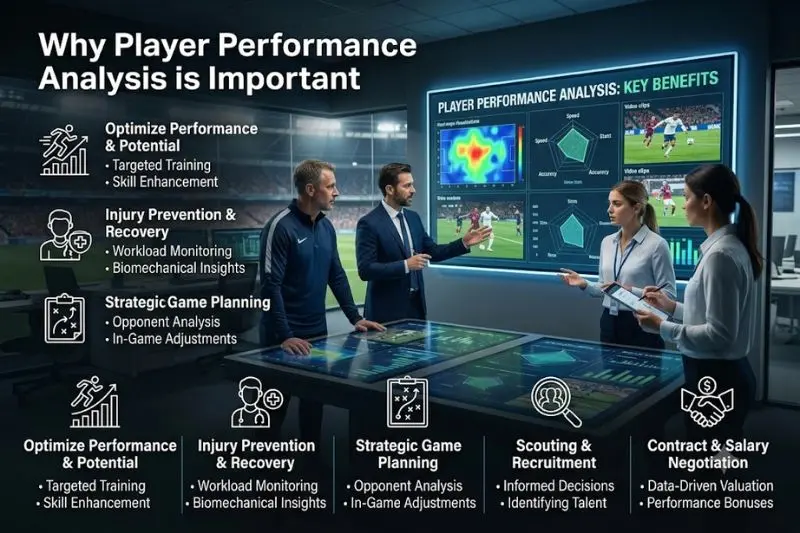
Performance analysis provides objective information that helps improve individual and team performance.
Its importance includes:
- Supports better coaching decisions.
- Identifies player strengths.
- Reveals weaknesses that need improvement.
- Measures progress over time.
- Assists in player selection.
- Reduces injury risks through workload monitoring.
- Improves tactical planning.
- Enhances team coordination.
- Increases consistency.
- Builds player confidence through measurable improvement.
Without proper analysis, many coaching decisions depend only on personal judgment. Data provides evidence that supports better planning and fair evaluation.
Detailed Step-by-Step Guide
Step 1: Define Your Objectives
Every analysis begins with a clear objective.
Examples include:
- Improving shooting accuracy
- Increasing passing success
- Monitoring player fitness
- Evaluating defensive positioning
- Comparing player performances
Clear objectives prevent unnecessary data collection and keep the analysis focused.
Step 2: Select Performance Metrics
Choosing the right metrics is essential.
Common technical metrics include:
- Goals scored
- Assists
- Passing accuracy
- Shooting percentage
- Ball possession
- Successful tackles
- Saves
- Turnovers
Physical metrics include:
- Sprint speed
- Distance covered
- Heart rate
- Recovery time
- Endurance
- Acceleration
Mental metrics may include:
- Decision-making
- Concentration
- Confidence
- Reaction under pressure
The selected metrics should match the player’s role and sport.
Step 3: Collect Reliable Data
Accurate data forms the foundation of Player Performance Analysis.
Data sources include:
- Match statistics
- Training records
- GPS tracking
- Video recordings
- Fitness assessments
- Wearable devices
- Coaching observations
Consistency is important. Collect data using the same methods over multiple sessions.
Step 4: Analyze Video Footage
Video analysis allows coaches and players to review situations repeatedly.
During video review, observe:
- Positioning
- Movement without the ball
- Communication
- Decision-making
- Timing
- Tactical awareness
Watching key moments often reveals mistakes that players fail to notice during live competition.
Step 5: Compare Performance Trends
Looking at trends is more valuable than evaluating one game.
Compare:
- Current vs previous matches
- Home vs away performances
- Practice vs competition
- First half vs second half
- Seasonal progress
Trend analysis helps identify improvement or decline.
Step 6: Interpret the Results
Statistics alone cannot explain everything.
For example, a player may complete fewer passes because the team’s strategy required more long balls rather than short possession.
Always combine numerical data with tactical understanding.
Step 7: Create Improvement Plans
The purpose of analysis is improvement.
Action plans should include:
- Specific goals
- Practice routines
- Fitness adjustments
- Tactical improvements
- Performance reviews
- Progress monitoring
Players should receive regular feedback based on measurable outcomes.
Benefits of Player Performance Analysis
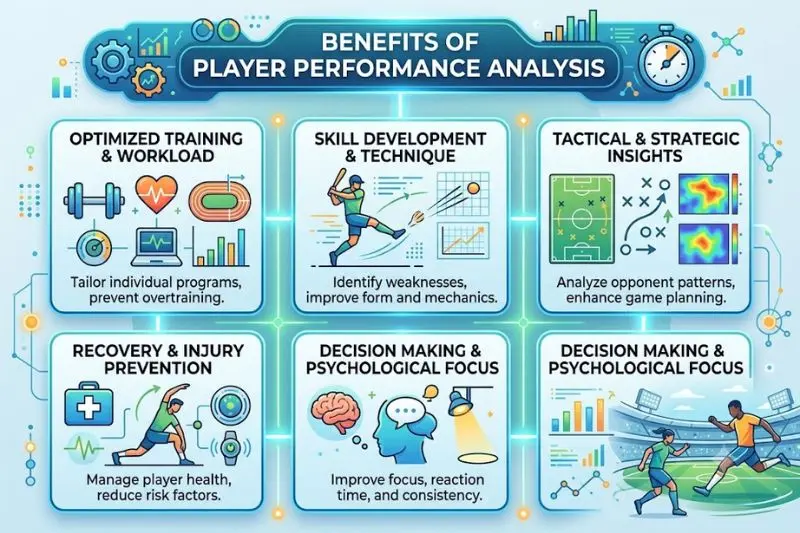
Player Performance Analysis offers numerous advantages for athletes and teams.
- Improves individual skills.
- Supports smarter coaching.
- Increases tactical awareness.
- Identifies hidden strengths.
- Detects weaknesses early.
- Tracks long-term development.
- Improves player confidence.
- Helps prevent overtraining.
- Supports fair team selection.
- Encourages objective evaluation.
- Enhances communication between coaches and players.
- Optimizes training sessions.
- Reduces unnecessary practice.
- Improves match preparation.
- Increases competitive performance.
These benefits make performance analysis valuable at every competitive level.
Disadvantages and Risks
Although highly beneficial, Player Performance Analysis also has limitations.
- Data collection can be expensive.
- Advanced software requires training.
- Too much data may become overwhelming.
- Incorrect interpretation may lead to poor decisions.
- Technology occasionally produces inaccurate measurements.
- Excessive monitoring may increase player pressure.
- Small sample sizes may create misleading conclusions.
- Focusing only on statistics may ignore leadership and teamwork.
A balanced approach combines statistical evidence with coaching experience.
Common Mistakes to Avoid
Many beginners make avoidable mistakes while analyzing player performance.
One common error is focusing on only one statistic. A football striker, for example, contributes more than goals alone. Movement, pressing, and passing also matter.
Another mistake is ignoring context. Weather conditions, opponent quality, injuries, and team tactics all influence performance.
Some analysts collect large amounts of information without identifying clear objectives. More data does not always mean better analysis.
Many coaches also compare players who perform completely different roles. Comparing a goalkeeper with a midfielder using identical statistics produces misleading results.
Finally, failing to provide constructive feedback reduces the value of the entire analysis process. Players improve faster when feedback is specific, practical, and encouraging.
What is the main purpose of Player Performance Analysis?
The primary purpose is to measure performance objectively, identify strengths and weaknesses, and improve future results through informed coaching and training decisions.
Is Player Performance Analysis useful for beginners?
Yes. Beginners benefit by learning correct techniques early, tracking improvement, and understanding which areas require additional practice
Which sports use Player Performance Analysis?
Almost every competitive sport uses performance analysis, including football, cricket, basketball, volleyball, tennis, baseball, hockey, rugby, athletics, swimming, and esports.
Can performance analysis help prevent injuries?
Yes. Monitoring workload, movement patterns, fatigue, and recovery helps coaches reduce injury risks while improving player fitness.
What tools are commonly used?
Popular tools include video analysis software, GPS trackers, heart-rate monitors, wearable fitness devices, performance dashboards, and statistical databases.
How often should Player Performance Analysis be conducted?
Ideally, analysis should occur after every training session or match, with larger reviews conducted weekly, monthly, and at the end of each season.
Expert Tips and Bonus Points
Professional analysts follow several best practices that improve the quality of Player Performance Analysis.
Always define measurable objectives before collecting data.
Record performances regularly instead of analyzing only important matches.
Use both statistics and video evidence to understand performance completely.
Focus on gradual improvement rather than immediate perfection.
Keep reports simple enough for players to understand.
Compare players against their previous performances instead of constantly comparing teammates.
Use positive feedback alongside constructive criticism.
Review progress consistently throughout the season.
Adjust training plans based on analysis rather than assumptions.
Remember that mental strength, teamwork, communication, and leadership often influence performance just as much as physical ability.
One additional strategy is maintaining a personal performance journal. Players who record training sessions, goals, recovery, and match experiences often recognize patterns that traditional statistics may overlook.
Conclusion
Player Performance Analysis has transformed the way athletes, coaches, and teams prepare for competition. By replacing guesswork with measurable information, it provides a clearer understanding of what influences success on the field, court, or pitch. From technical skills and tactical awareness to physical conditioning and mental preparation, every aspect of an athlete’s performance can be evaluated and improved through a structured analysis process.
The most successful organizations understand that performance analysis is not simply about collecting statistics. Instead, it is about turning information into practical improvements that help players develop consistently over time. When combined with effective coaching, disciplined training, and regular feedback, analysis becomes a powerful tool for achieving long-term success.
Beginners should focus on learning the fundamentals by selecting a few meaningful performance indicators rather than tracking every available statistic. Intermediate athletes and coaches can gradually incorporate advanced technologies, video review, and trend analysis to gain deeper insights. Consistency remains the key to meaningful evaluation.
Although Player Performance Analysis has certain limitations, its advantages greatly outweigh the challenges when applied correctly. By collecting reliable data, interpreting results carefully, setting realistic goals, and continuously monitoring progress, players can maximize their potential while helping their teams perform at higher levels. Whether your goal is personal improvement, coaching excellence, or competitive success, mastering Player Performance Analysis is a valuable investment that delivers lasting results.
